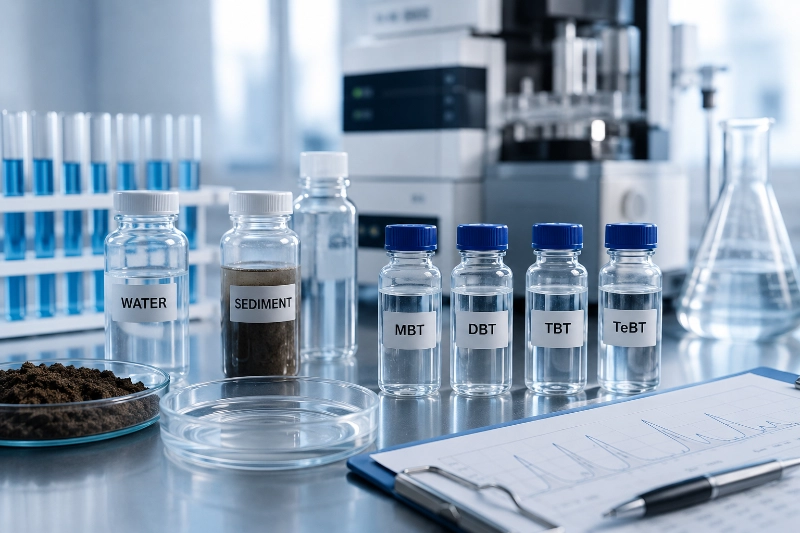
Organotin testing is commonly requested for projects involving sediment assessment, marine or harbor investigations, dredging support, industrial source evaluations, and environmental monitoring. Because organotin compounds are much more toxic than inorganic tin, speciated organotin testing is often required for aquatic projects.
Organotin compounds were most commonly used as an anti-fouling biocide in marine and aquatic coatings. MAI supports projects requiring reliable and very low sensitivity organotin data, including mono- through tetrabutyl tin speciation in a variety of regulated matrices.
MAI provides targeted organotin analysis to help clients evaluate project-specific compounds, matrices, reporting needs, and regulatory or disposal requirements.
Common Organotin Testing Applications
- Sediment and dredging investigations
- Marine and harbor contamination assessments
- Industrial wastewater and process evaluations
- Stormwater and runoff investigations
- Soil and site characterization projects
- Specialty organometallic studies
- Environmental compliance and monitoring support
- Disposal or material characterization support
Common Organotin Compounds
- Monobutyltin (MBT)
- Dibutyltin (DBT)
- Tributyltin (TBT)
- Tetrabutyltin (TeBT)
- Other organotin compounds may be possible upon request
Common Matrices Tested
- Sediment
- Soil
- Sludge
- Solids
- Water
- MET
- DISTLC
- Pore Water
- Wastewater
- Stormwater
- Marine Organisms: Clams (Macoma Clams and Nereis worms)
- Other tissue matrices may be available upon request
- Wastewater
- Stormwater
- Sludge
- Solids
- Industrial materials
- Specialty matrices upon review
Organotin Methods & Reporting Limits
We are currently offering a low-level GC/MS/MS method for sediment, soil,
and other solid matrices. We also offer standard GC/MS methods for both
water and solid samples. The Reporting Limits (RL) are listed in the table below. We are currently set up for select tissue matrices. Please contact us to discuss specific tissue types and project requirements.
| Method |
Matrix |
Analyte |
CAS |
PQL (RL)
(µg/L) |
Standard
GC-MS
|
Water
|
Monobutyltin cation |
78763-54-9 |
0.037 |
| Dibutyltin cation |
878794-24-2 |
0.046 |
| Tributyltin cation |
36643-28-4 |
0.053 |
| Tetrabutyltin |
1461-25-2 |
0.060 |
| Method |
Matrix |
Analyte |
CAS |
PQL (RL)
(mg/kg) |
Standard
GC-MS
|
Solid
|
Monobutyltin cation |
78763-54-9 |
0.012 |
| Dibutyltin cation |
878794-24-2 |
0.015 |
| Tributyltin cation |
36643-28-4 |
0.018 |
| Tetrabutyltin |
1461-25-2 |
0.020 |
| Method |
Matrix |
Analyte |
CAS |
PQL (RL) |
Low Level
GC/MS/MS
|
Sediment/
Soil/Solid
|
Monobutyltin cation |
78763-54-9 |
0.16 |
| Dibutyltin cation |
878794-24-2 |
0.19 |
| Tributyltin cation |
36643-28-4 |
0.23 |
| Tetrabutyltin |
1461-25-2 |
0.25 |
Frequently Asked Questions
Organotin Project Planning Support
Organotin analyses often require careful consideration of target compounds, sample matrices, reporting limits, and project objectives. Whether your project involves sediment investigations, marine assessments, industrial facilities, wastewater studies, or specialty environmental monitoring, MAI can help ensure the appropriate analytical approach is selected before sampling.
Related Environmental Testing Services
Organotin projects often overlap with other environmental testing needs.
MAI also provides
Dredge & Sediment Testing,
Metals Testing,
Methyl Mercury Testing,
Hazardous Waste Testing, and
PFAS Testing
for environmental, industrial, and marine investigations.
Need Help with Organotin Testing?
If you are unsure which organotin compounds, reporting limits, sample containers, preservation requirements, or turnaround times apply to your project, contact MAI before sampling. Our team can review your project requirements and help determine the most appropriate analytical approach.
For assistance with organotin testing, call (877) 252-9262 or email
main@mccampbell.com.