Waste Profiling & Disposal Characterization
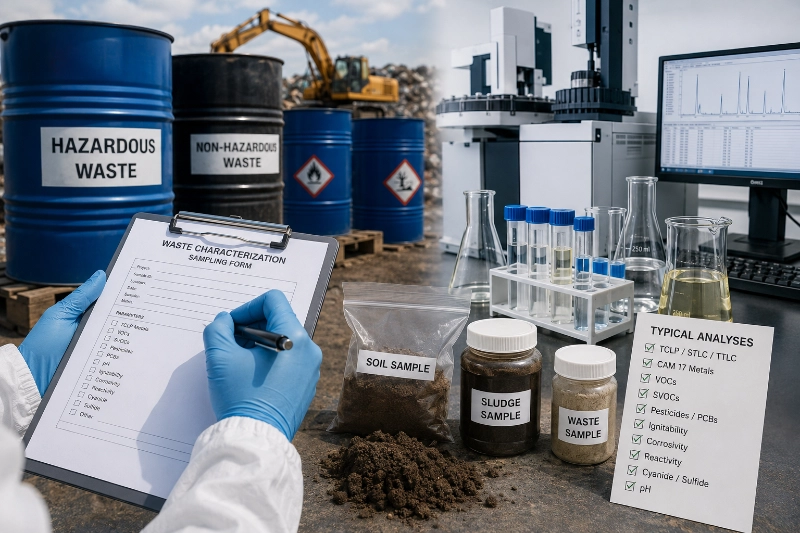
Hazardous waste characterization testing is commonly required to determine proper handling, transportation, treatment, recycling, or disposal options for environmental and industrial waste materials. MAI provides analytical support for hazardous and non-hazardous waste profiling projects using California Title 22 and federal EPA analytical methodologies.
Testing capabilities include metals, VOCs, SVOCs, pesticides, PCBs, ignitability, corrosivity, reactivity, cyanide, sulfide, oil and grease, aquatic toxicity evaluations, and additional project-specific analytical parameters commonly associated with landfill disposal acceptance, remediation waste streams, industrial process waste, contaminated soil, sludge, and environmental investigations.
Common Hazardous Waste Characterization Services
- Contaminated soil disposal characterization
- Industrial process waste testing
- Remediation waste profiling
- VOC and SVOC hazardous waste analysis
- Pesticides and PCB characterization
- Ignitability, corrosivity, and reactivity testing
- Cyanide and sulfide analysis
- Wastewater and sludge characterization
- Non-hazardous waste profiling
- Drum waste and unknown material characterization
Common Matrices Tested
- Soil
- Sludge
- Sediment
- Wastewater
- Solids
- Ash
- Petroleum Waste
- Industrial Waste
- Remediation Waste
Common Analytical Methods & Parameters
-
Element Testing
- CAM 17 Metals – EPA 6020 / 7471
- Cr(VI) – SW7199
- TCLP Extraction – EPA 1311
- STLC / DISTLC – CA Title 22 “WET”
-
Organics
- Volatile Organic Compounds (VOCs) – EPA 8260D
- Semi-Volatile Organic Compounds (SVOCs) – EPA 8270E
- Pesticides & PCBs – EPA 8081 / 8082
-
RCI Testing
- Reactive Sulfide & Cyanide – EPA 9010 / 9030
- Corrosivity – EPA 9040 / 9045
- Ignitability – EPA 1010
- Miscellaneous
- Oil & Grease – EPA 1664A
- TCDD – EPA 1613B
- TPH(g,d,k,o)
- Herbicides
Understanding the California 10x Rule
California hazardous waste regulations commonly use the “10x rule” as a screening
approach when evaluating whether Soluble Threshold Limit Concentration (STLC)
testing may be necessary.
In general, if a Total Threshold Limit Concentration (TTLC) result is less than
10 times the applicable STLC value, the waste mathematically cannot exceed the STLC threshold under California Title 22 regulations.
If the TTLC concentration equals or exceeds 10 times the STLC limit,
additional STLC testing may be recommended to further evaluate hazardous
waste classification requirements.
McCampbell Analytical provides TCLP, STLC, TTLC, CAM 17 metals, VOC,
SVOC, pesticide, PCB, and additional hazardous waste characterization testing
services for disposal profiling, remediation projects, industrial waste streams,
and regulatory compliance support.
For additional California hazardous waste information, visit the
California Department of Toxic Substances Control (DTSC)
.
Aquatic Toxicity Hazardous Waste Testing
In addition to chemical analysis, some hazardous waste evaluations may require
acute aquatic toxicity testing. California hazardous waste criteria include
aquatic toxicity based on a 96-hour fish bioassay, where the LC50
value is used to evaluate whether a waste exhibits acute aquatic toxicity.
MAI offers Acute 96-Hour Fish Bioassay testing using fathead minnows, with
Polisini & Miller (CDFG, 1988) as the method reference. This testing may be used
to support California Title 22 hazardous waste characterization, disposal
profiling, and project-specific regulatory evaluations.
Under California aquatic toxicity criteria, a waste is considered hazardous for
acute aquatic toxicity when the 96-hour LC50 is less than 500 mg/L.
MAI also provides accredited aquatic toxicity bioassay services for
hazardous waste determination, NPDES compliance, sediment assessment,
and Whole Effluent Toxicity (WET) testing. Learn more on our
Aquatic Toxicity Testing page
.
Low-Level SVOC & California TTLC Compliance Testing
Certain California hazardous waste and landfill acceptance criteria require
Semi-Volatile Organic Compound (SVOC) reporting limits below standard analytical
detection capabilities. To better support hazardous waste characterization and
waste acceptance requirements, MAI developed specialized low-level SIM-based
analytical approaches designed to help achieve California TTLC regulatory limits.
-
8270E Full CA TTLC Reg List
-
Extended Low-Level SVOC & PNA Package
-
Gel Permeation Chromatography (GPC) cleanup is typically recommended
for improved analytical performance and matrix interference reduction.
ReGen Monterey Waste Acceptance Support
MAI provides analytical testing support for projects requiring comparison
to ReGen Monterey waste acceptance thresholds, including inorganic compounds,
petroleum hydrocarbons, VOCs, SVOCs, CAM 17 metals, and additional
California hazardous waste criteria.
MAI can provide laboratory data comparisons and reporting support
for ReGen Monterey acceptance criteria and related waste profiling projects.
Frequently Asked Questions
Hazardous waste characterization testing is used to determine whether a waste material meets state or federal hazardous waste criteria for handling, transportation, treatment, recycling, or disposal. Testing may include metals, VOCs, SVOCs, pesticides, PCBs, ignitability, corrosivity, reactivity, cyanide, sulfide, and other analytical parameters.
TCLP (Toxicity Characteristic Leaching Procedure) is federally defined and evaluates the leaching potential of contaminants from a waste material using an acetic acid buffer. STLC (Soluble Threshold Limit Concentration) is State of California defined and evaluates the leaching potential of contaminants from a waste material using a citric acid buffer and is generally more stringent than the TCLP. TTLC (Total Threshold Limit Concentration) values result from EPA defined method specific extractions such as using strong acids to leach solids for metals and organic solvents to extract organic contaminants. STLC and TTLC limits are uniquely defined in California Title 22 and are commonly used to classify hazardous waste for disposal or abatement purposes. TCLP use a 20:1 fluid:solid ratio whereas STLC uses 10:1 fluid:solid ratio and neither extraction ratio is factored into the results which are reported in mg analyte/L extraction fluid. TTLC results account for their extraction factor, leading to the 10x rule for STLC and the 20x rule for TCLP.
MAI can analyze soils, sludge, sediment, wastewater, solids, petroleum-impacted materials, industrial process waste, remediation waste, drum waste, ash, and other environmental or industrial waste streams.
Landfill acceptance requirements, disposal thresholds, and analytical
criteria may vary by facility and can change over time. Clients should
confirm current acceptance requirements directly with the receiving
landfill or disposal facility prior to sampling or waste disposal.
We are typically able to meet landfill STLC/TCLP triggers and disposal limits,
including for the following landfills:
Altamont, Keller Canyon, Potrero Hills, Redwood, Guadalupe, Kirby Canyon,
Forward/Ox Mountain, Kiefer, Yolo County Central, Ostrom Road,
Lodi Recycling & Recovery, Foothill Sanitary, Hay Road,
Clover Flat, Central Disposal Site, and Ukiah Disposal Site.
Common analytical methods may include EPA 1311 (TCLP), STLC, EPA 8260 (VOCs), EPA 8270 (SVOCs), EPA 6020 (metals), EPA 8081/8082 (pesticides and PCBs), and additional Title 22 or project-specific methodologies.
Rush turnaround times may be available depending on project requirements, analytical methods, and laboratory capacity. Please contact the laboratory directly to discuss scheduling needs.
Federal & California Regulated Hazardous Waste Compounds
The table below summarizes commonly regulated hazardous waste constituents and their
associated federal and California regulatory thresholds. Final limits should be confirmed
against the current regulatory requirements and project-specific disposal criteria as federal and state regulations frequently change and are subject to interpretation.
Download Full Hazardous Waste Limits Reference Sheet (PDF)
| Contaminant |
MAI Analytical Method |
CAS Number |
TTLC
(mg/kg) |
STLC
(mg/L) |
Federal TCLP
(mg/L) |
| Aldrin | 8081 | 309-00-2 | 1.4 | 0.14 | — |
| Antimony | 200.8 / 6020 | 7440-36-0 | 500 | 15 | — |
| Arsenic | 200.8 / 6020 | 7440-38-2 | 500 | 5 | 5 |
| Asbestos | — | — | 1%b | — | — |
| Barium | 200.8 / 6020 | 7440-39-3 | 10,000c | 100 | 100 |
| Beryllium | 200.8 / 6020 | 7440-41-7 | 75 | 0.75 | — |
| Benzene | 8260 | 71-43-2 | 10i | — | 0.5 |
| Lindane | 8081 | 58-89-9 | 4 | 0.4 | 0.4 |
| Cadmium | 200.8 / 6020 | 7440-43-9 | 100 | 1 | 1 |
| Carbon Tetrachloride | 8260 | 56-23-5 | 10i | — | 0.5 |
| Chlordane | 8081 | 57-74-9 | 2.5 | 0.25 | 0.03 |
| Chlorobenzene | 8260 | 108-90-7 | 2000i | — | 100 |
| Chloroform | 8260 | 67-66-3 | 120i | — | 6 |
| Chromium, Total | 200.8 / 6020 | 7440-47-3 | 2500 | 5 | 5 |
| Chromium (VI) | 218.6 / 7199 | 18540-29-9 | 500g | 5g | — |
| Cobalt | 200.8 / 6020 | 7440-48-4 | 8000 | 80 | — |
| Copper | 200.8 / 6020 | 7440-50-8 | 2500 | 25 | — |
| Cresolf | 8270 | — | 4000i | — | 200 |
| o-Cresol | 8270 | 95-48-7 | 4000i | — | 200 |
| m-Cresol | 8270 | 108-39-4 | 4000i | — | 200 |
| p-Cresol | 8270 | 106-44-4 | 4000i | — | 200 |
| 2,4-D | 8151 | 94-75-7 | 100 | 10 | 10 |
| DDT / DDE / DDD | 8081 | — | 1 | 0.1 | — |
| 1,4-Dichlorobenzene | 8260 | 106-46-7 | 150i | — | 7.5 |
| 1,2-Dichloroethane | 8260 | 107-06-2 | 10i | — | 0.5 |
| 1,1-Dichloroethene | 8260 | 75-35-4 | 14i | — | 0.7 |
| 2,4-Dinitrotoluene | 8270 | 121-14-2 | 2.6i | — | 0.13 |
| Dieldrin | 8081 | 60-57-1 | 8 | 0.8 | — |
| Dioxin (2,3,7,8-TCDD) | 1613 | 1746-01-6 | 0.01 | 0.001 | — |
| Endrin | 8081 | 72-20-8 | 0.2 | 0.02 | 0.02 |
| Fluoride Salts as F | 300.0 / 300.1 | 16984-48-8 | 18,000 | 180 | — |
| Heptachlor / Heptachlor Epoxidee | 8081 | 76-44-8 | 4.7 | 0.47 | 0.008 |
| Hexachlorobenzene | 8081 | 118-74-1 | 2.6i | — | 0.13 |
| Hexachlorobutadiene | 8260 | 87-68-3 | 10i | — | 0.5 |
| Hexachloroethane | 8260 | 67-72-1 | 60i | — | 3 |
| Kepone | 8081 | 143-50-0 | 21 | 2.1 | — |
| Lead | 200.8 / 6020 | 7439-92-1 | 1000 | 5 | 5 |
| Lead, Organic | MAI OPBMS | — | 13 | — | — |
| MEK (Methyl Ethyl Ketone) | 8260 | 78-93-3 | 4000i | — | 200 |
| Mercury | 200.8 / 6020h | 7439-97-6 | 20 | 0.2 | 0.2 |
| Methoxychlor | 8081 | 72-43-5 | 100 | 10 | 10 |
| Mirex | 8081 | 2385-85-5 | 21 | 2.1 | — |
| Molybdenum | 200.8 / 6020 | 7439-98-7 | 3500d | 350 | — |
| Nickel | 200.8 / 6020 | 7440-02-0 | 2000 | 20 | — |
| Nitrobenzene | 8270 | 98-95-3 | 40i | — | 2 |
| PCBs (Polychlorinated Biphenyls), Total | 8082 | — | 50 | 5 | — |
| Pentachlorophenol | 8270 | 87-86-5 | 17 | 1.7 | 100 |
| pH (Corrosivity from RCI)j | 150.1 | 12408-02-5 | pH ≤ 2.0 or pH ≥12.5 units | — | — |
| Pyridine | 8270 | 110-86-1 | 100i | — | 5 |
| Selenium | 200.8 / 6020 | 7782-49-2 | 100 | 1 | 1 |
| Silver | 200.8 / 6020 | 7440-22-4 | 500 | 5 | 5 |
| Tetrachloroethene | 8260 | 127-18-4 | 14i | — | 0.7 |
| Thallium | 200.8 / 6020 | 7440-28-0 | 700 | 7 | — |
| Toxaphene | 8081 | 8001-35-2 | 5 | 0.5 | 0.5 |
| 2,4,5-TP (Silvex) | 8151 | 93-72-1 | 10 | 1 | 1 |
| Trichloroethene | 8260 | 79-01-6 | 2040 | 204 | 0.5 |
| 2,4,5-Trichlorophenol | 8270 | 95-95-4 | 8000i | — | 400 |
| 2,4,6-Trichlorophenol | 8270 | 88-06-2 | 40i | — | 2 |
| Vanadium | 200.8 / 6020 | 7440-62-2 | 2400 | 24 | — |
| Vinyl Chloride | 8260 | 75-01-4 | 4i | — | 0.2 |
| Zinc | 200.8 / 6020 | 7440-66-6 | 5000 | 250 | — |
| Acute Aquatic 96-Hour Bioassay | Polisini and Miller | — | LC50 > 500 mg/L |
Additional Federal Toxicity Characteristic Compounds
The following compounds are listed in the MAI hazardous waste limits reference table as
Federal TCLP contaminants that must be below 0.001% by weight.
| Contaminant |
MAI Analytical Method |
CAS Number |
TTLC
(mg/kg) |
STLC
(mg/L) |
Federal TCLP
(mg/L) |
| 2-Acetylaminofluorene (2-AAF) | — | 53-96-3 | 10 | 10 | 10 |
| Acrylonitrile | 8260 | 107-13-1 | 10 | 10 | 10 |
| 4-Aminodiphenyl | 8270 | 92-67-1 | 10 | 10 | 10 |
| Benzidine and its Salts | 8270 | 92-87-5 | 10 | 10 | 10 |
| bis Chloromethyl Ether (BCME) | 8260 | 60-29-7 | 10 | 10 | 10 |
| Methyl Chloromethyl Ether | — | 107-30-2 | 10 | 10 | 10 |
| 1,2-Dibromo-3-Chloropropane (DBCP) | 8260 | 96-12-8 | 10 | 10 | 10 |
| 3,3'-Dichlorobenzidine and its Salts | 8270 | 91-94-1 | 10 | 10 | 10 |
| 4-Dimethylaminoazobenzene (DAB) | 8270 | 60-11-7 | 10 | 10 | 10 |
| Ethyleneimine (EI) | — | 151-56-4 | 10 | 10 | 10 |
| alpha-Naphthylamine (1-NA) | 8270 | 134-32-7 | 10 | 10 | 10 |
| beta-Naphthylamine (2-NA) | 8270 | 91-59-8 | 10 | 10 | 10 |
| 4-Nitrobiphenyl | — | 92-93-3 | 10 | 10 | 10 |
| N-Nitrosodimethylamine (DMN) | 8270 | 62-75-9 | 10 | 10 | 10 |
| beta-Propiolactone (BPL) | — | 57-57-8 | 10 | 10 | 10 |
| Vinyl Chloride (VCM) | 8260 | 75-01-4 | 10 | 10 | 10 |