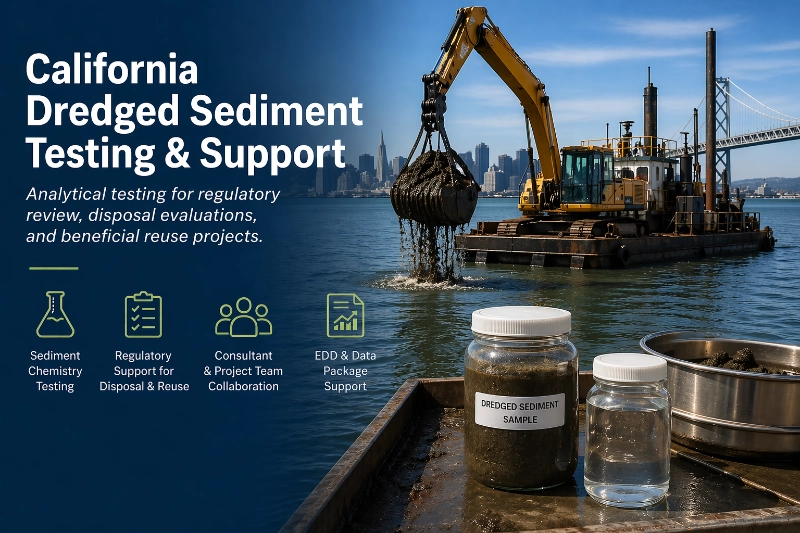
California Dredged Sediment Testing
McCampbell Analytical, Inc. (MAI) provides analytical support for dredged sediment characterization projects throughout California. Dredging projects often require sediment testing before material can be approved for disposal, aquatic placement, ocean disposal, or beneficial reuse. In the San Francisco Bay region, dredged material review commonly moves through the Dredged Material Management Office (DMMO), an interagency process that reviews sediment quality sampling plans, testing results, and suitability for disposal or reuse.
MAI supports environmental consultants, ports, marinas, municipalities, engineers, and project teams with laboratory testing for sediment characterization programs tied to California dredging and sediment management projects. Requirements vary depending on project location, disposal pathway, and agency review, so analytical needs should be aligned with project-specific guidance.
For projects involving organotin compounds, MAI also provides
organotin testing and butyltin speciation,
including low-level GC/MS/MS analysis for sediment, soil, and other solid matrices.
When Dredged Sediment Testing Is Needed
Dredged sediment testing may be required for a range of California projects, including maintenance dredging, marina and harbor dredging, channel deepening, sediment disposal evaluations, aquatic placement reviews, ocean disposal projects, and beneficial reuse efforts. In California, review pathways differ depending on where the material is proposed to go and which agencies have jurisdiction over the project.
California Regulatory Review for Dredged Sediment
In the San Francisco Bay region, the DMMO provides a coordinated interagency review process for dredging and dredged-material disposal or reuse projects. According to the U.S. Army Corps of Engineers, the DMMO cooperatively reviews sediment quality sampling plans, analyzes sediment quality sampling results, and makes suitability determinations for material proposed for disposal in San Francisco Bay.
For ocean disposal in California, EPA Region 9 states that dredged material disposal sites in the region are managed under the Marine Protection, Research, and Sanctuaries Act, with EPA and the U.S. Army Corps of Engineers sharing important responsibilities in the permitting and management framework.
In Southern California, dredging projects may be discussed through the Southern California Dredged Material Management Team (SC-DMMT), which continues to review projects across counties including Los Angeles, Orange, San Diego, Ventura, Santa Barbara, and San Luis Obispo.
Project requirements vary, but dredged sediment characterization may involve chemistry testing for sediment quality evaluation and, depending on the disposal or reuse option, additional technical review related to suitability determinations. MAI can support project teams with analytical testing as part of broader sediment characterization programs and consultant-led sampling efforts.
What We Offer
- Sediment chemistry testing
- Support for consultant sampling programs
- Long term preservation of marine sediment at –18 ± 2 °C
- Data packages and EDD support, if requested
- Coordination of analytes, matrices, and turnaround times
- California-focused support for dredging and sediment management projects
Projects We Support
- Ports and terminals
- Harbors and marinas
- Navigation channel maintenance
- Flood control and public works projects
- Sediment disposal evaluations
- Beneficial reuse and wetland restoration-related projects
Why Choose McCampbell Analytical?
Located in the San Francisco Bay Area, MAI provides responsive laboratory support for environmental projects throughout Northern California. We work with environmental professionals who need reliable analytical data for complex sediment management and dredging-related projects, with support tailored to project scope, matrix, and regulatory pathway.
Need support for a California dredged sediment project?
Contact McCampbell Analytical to discuss your sediment characterization needs, project requirements, and turnaround options. main@mccampbell.com | (877) 252-9262