• McCampbell Analytical, Inc.
  • Connected With Us
  • 1534 Willow Pass Road Pittsburg, CA 94565

Full-Service Environmental Laboratory with 35 Years of Proven Quality and Expertise

Accredited Testing. Fast Turnaround. Trusted Results

  • Certified & Accredited (NELAP ELAP DoD USDA AIHA-LAP)
  • Rapid Turnaround Times & Responsive Service
  • Experienced Support for Complex Projects

SPOTLIGHT: Dredge & Sediment Testing

Comprehensive sediment testing to support dredging projects, disposal determinations, beneficial reuse evaluations, and regulatory compliance requirements.

ATR-IR Spectroscopy Services

Fast, reliable FTIR and ATR-IR analysis for unknown material identification, polymers, plastics, coatings, residues, fibers, oils, adhesives, and quality control investigations.

ATR-IR & FTIR Material Identification

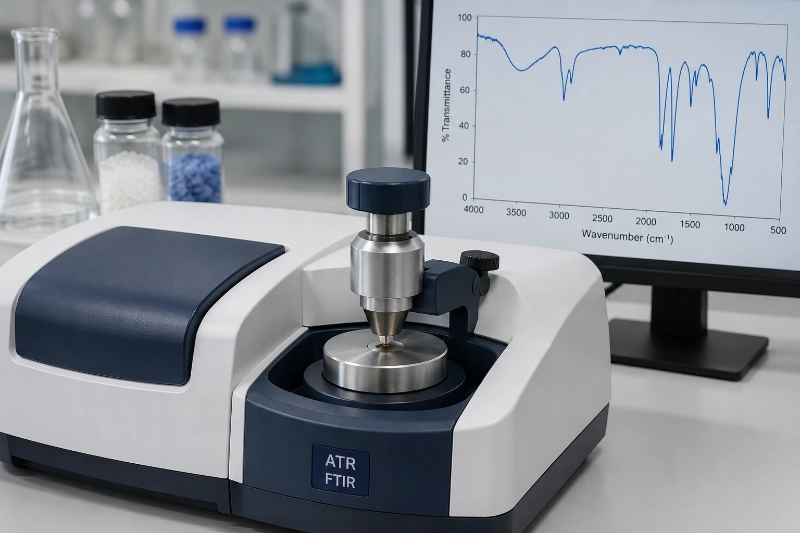
McCampbell Analytical, Inc. (MAI) provides Attenuated Total Reflectance Infrared Spectroscopy (ATR-IR) and Fourier Transform Infrared Spectroscopy (FTIR) analysis for identifying unknown materials, residues, coatings, polymers, plastics, fibers, oils, adhesives, and other organic or inorganic substances.

ATR-IR is a fast and effective analytical technique for determining material composition by measuring how a sample absorbs infrared light. The resulting infrared spectrum acts like a molecular fingerprint, allowing unknown materials to be compared against reference spectra for identification and characterization.

What ATR-IR Can Determine

  • Unknown material identification
  • Polymer and plastic identification
  • Coating, paint, adhesive, and sealant characterization
  • Residue, film, fiber, and particle screening
  • Oil, resin, and organic material evaluation
  • Comparison of raw materials, finished products, or process samples
  • Quality control screening and accept/reject comparisons

Common ATR-IR Applications

ATR-IR is useful when clients need a rapid material characterization tool for troubleshooting, quality control, contamination investigations, and unknown material screening. Typical applications include:

  • Identifying unknown residues or deposits
  • Determining polymer or plastic type
  • Evaluating coatings, paints, laminates, and films
  • Screening adhesives, epoxies, resins, and sealants
  • Characterizing fibers, including synthetic and natural fibers
  • Comparing a product sample to a known reference material
  • Investigating contamination in manufacturing or process systems
  • Supporting research, development, and product troubleshooting

Sample Types Commonly Analyzed

  • Solids and powders
  • Non-aqueous liquids
  • Plastics and polymers
  • Paints, coatings, and laminates
  • Fibers and films
  • Oils, greases, and resins
  • Adhesives, epoxies, and sealants
  • Unknown residues, particles, and deposits

Qualitative and Quantitative Analysis

Qualitative ATR-IR analysis is commonly used to identify unknown materials or compare a sample against known reference materials. This can be especially helpful for quality control, product investigations, and contamination screening.

Quantitative FTIR or ATR-IR analysis may be possible when an appropriate calibration curve or reference standard is available. Quantitative analysis is project-specific and should be discussed with the laboratory before sample submission.

ATR-IR vs. XRD

ATR-IR and XRD provide different types of material information. ATR-IR is commonly used for organic materials, polymers, coatings, fibers, oils, and residues. X-Ray Diffraction (XRD) is commonly used to identify crystalline compounds, minerals, polymorphs, and inorganic solids.

If you are unsure which method is best for your material, MAI can help review the sample type and project objective before analysis.

Sample Submission Guidelines

For best results, submit a representative sample in a clean, dry container. If you have a known reference material for comparison, submit that material separately and clearly label each sample.

  • Small amounts of material may be sufficient depending on the project goal
  • Submit solids, films, fibers, residues, or non-aqueous liquids in clean containers
  • Provide background information about the sample source and suspected material, if known
  • Include any known reference or control sample when comparison is needed
  • Contact MAI before submitting limited, unusual, hazardous, or high-priority samples

Related Services

Need crystalline phase or mineral identification? Visit our X-Ray Diffraction (XRD) Material Identification page.

Need workplace exposure monitoring for silica dust? Visit our Respirable Crystalline Silica Testing page.

Need Help with ATR-IR Testing?

Contact McCampbell Analytical to discuss your material, sample type, project goal, and turnaround needs. Our team can help determine whether ATR-IR, FTIR, XRD, or another analytical technique is most appropriate.

For assistance with ATR-IR material identification, call (877) 252-9262 or email main@mccampbell.com.

FAQs

What is ATR-IR used for?

ATR-IR is used to identify unknown materials by evaluating their infrared absorption spectrum. It is commonly used for polymers, plastics, coatings, fibers, residues, oils, adhesives, and other materials.

How is ATR-IR different from XRD?

ATR-IR is typically used for organic materials, polymers, coatings, fibers, and residues. XRD is typically used for crystalline compounds, minerals, polymorphs, and inorganic solids.

Can ATR-IR identify unknown residues?

Yes. ATR-IR is commonly used to screen unknown residues, films, particles, and deposits by comparing the sample spectrum to reference materials and spectral libraries.

What sample types can be submitted for ATR-IR?

Common sample types include solids, powders, plastics, polymers, coatings, films, fibers, adhesives, oils, greases, resins, and non-aqueous liquids.

Do you help determine whether ATR-IR is the right test?

Yes. MAI can review your sample type, project goal, suspected material, and reporting needs to help determine whether ATR-IR, FTIR, XRD, or another analytical technique is most appropriate.